On the AI Stage in Bern
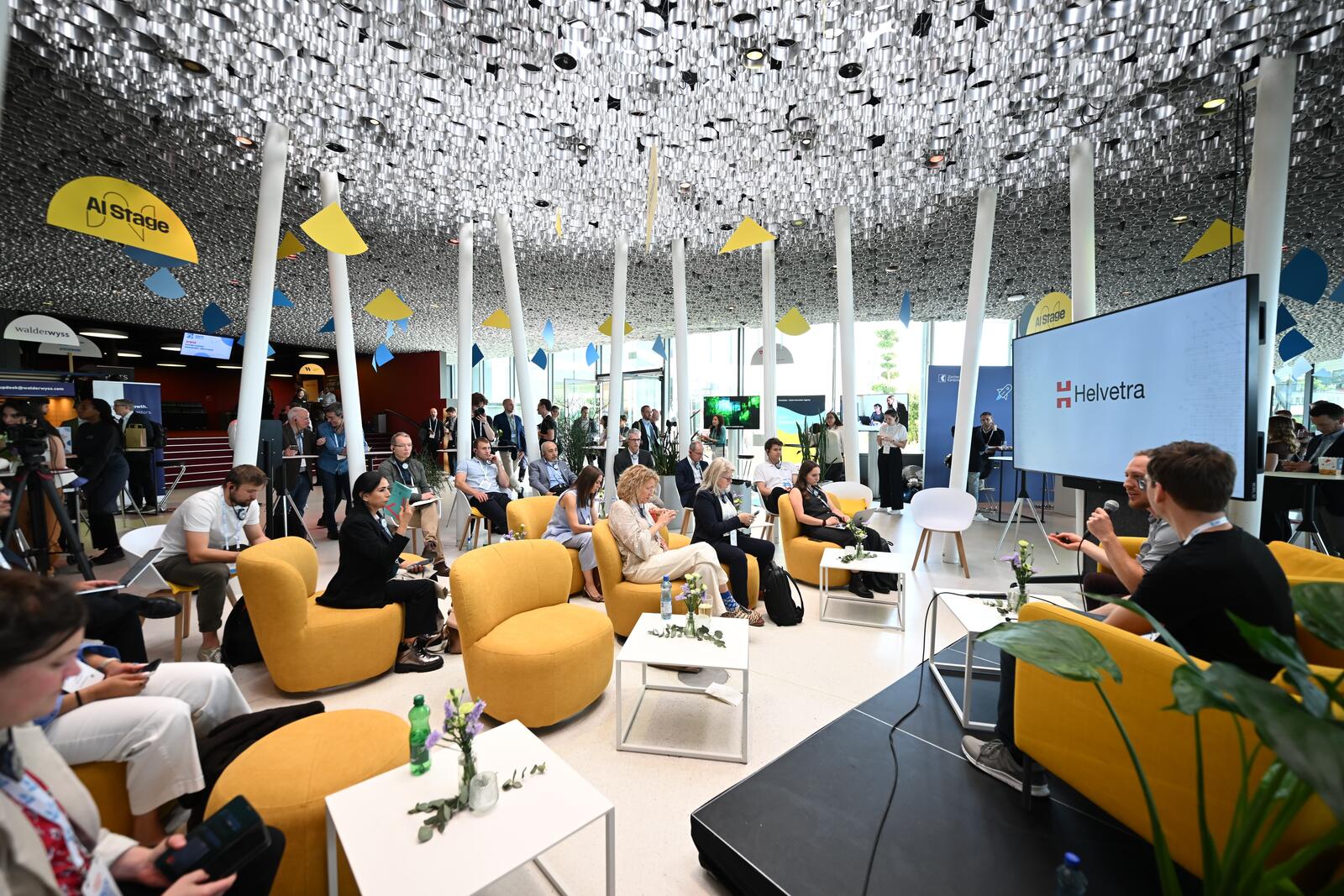
On 21 May 2026, Swiss Startup Days took over the Kursaal in Bern: 40-plus sessions, 125-plus speakers, the usual deep-tech, fintech and health-tech tracks, and this year a dedicated AI Stage running the whole day. The slot on that AI Stage belonged to Apertus, and Oleg Lavrovsky brought Helvetra along as the small-product half of a fireside chat titled "Open Source AI as a Strategic Advantage".
Oleg is Data Engineer and Developer Relations Specialist on the Apertus team at the EPFL AI Center, working closely with the ETH AI Center. He framed where Apertus sits in the global picture; Helvetra was the small product in the room actually shipping on top of it. The full 32-minute recording is on YouTube; this article is what it makes sense to expand on for Helvetra users.
Why Helvetra exists at all
Helvetra started as an itch from a different company. Alex also runs Peerdom, where multilingual teams are the norm rather than the exception, and translation is a recurring chore. For Swiss and European organisations, the existing options also come with a quieter friction: where the text actually goes once you press translate, and who gets to keep it.
When Apertus shipped its first release in September 2025, hosted on Infomaniak, the missing piece appeared on a Swiss server. The decision to build Helvetra was made the same week.
On stage, Alex described it in the most low-stakes terms possible: a tool built in evenings, on top of a model that already existed, to solve a problem he already had. It happens to also serve anyone else in Switzerland who works across languages.
Open by default, not by accident
The opening claim of the session was simple. Open source is not a hobbyist position; for a small Swiss product it is the only credible strategic posture against US-scale incumbents.
Helvetra puts that into practice. All three of our codebases live on GitHub under the Helvetra organisation: the Nuxt frontend, the FastAPI backend, and the iOS app. Anyone can read what we send to Apertus, how we handle a session, what we store and (more importantly) what we don't.
The privacy piece is structural, not a policy paragraph. The text you type is sent to Apertus, the translation comes back, the page renders it. No database row is created for that text. The only optional moment is the thumbs-up / thumbs-down button: when you press it, we ask whether you want to share that one example to help us improve. Otherwise, nothing is kept.
During the Q&A, Oleg made the obvious open-source invitation explicit: the iOS app is on GitHub, but there is no Android client yet. If you live in the Android world and want one, the code that would help you write it is right there.
The honest current state
Alex was upfront on stage about how small Helvetra is: no marketing budget, no growth team, no founder full-time on the product. The framing was deliberate. Helvetra is supposed to be quietly useful, not loudly launched. The shape of the audience right now matches that.
"I really didn't build that to sustain myself. I rather built it because I thought the product here outside is just awesome, and let's just do something."
The most honest caveat is Swiss German. As Imanol Schlag (Apertus co-lead) said at Uphill Conf two weeks earlier, the current Apertus checkpoint only saw Swiss German for a single day of post-training. That shows. The Swiss German that comes out of Helvetra today is fine for a casual chat message, and still rough enough that we'd want a native speaker to read over anything you actually send to someone.
Apertus 1.5 is the next checkpoint, and Oleg recapped what it brings: roughly two trillion additional training tokens (with health, education and justice data contributed by partner organisations), image and audio inputs, and an agentic / instruction-following pass via reinforcement learning. After 1.5, Apertus 2 is being designed for release at the end of 2026 with a mixture-of-experts architecture. Each of those release windows is also a release window for Helvetra: when the model gets better at Swiss German, our output does, with no work on our side.
A modest target
Asked whether it would be disappointing if Helvetra were used only by, say, twenty Swiss cantons, Alex's answer was that it would already be a good outcome. The honesty is the point. Helvetra doesn't need to win a category; it needs to be useful to the people who already live with the problem it solves.
That is the indie-product version of the open-source thesis from the session: a small team can put a real Swiss-built tool in front of users without permission, without a funding round, and without compromising on data residency. The conversation in Bern was a useful reminder that we are not the only people making that bet.
Resources
- The talk on YouTube: Open Source AI as a Strategic Advantage (32 min, Swiss Startup Days 2026)
- Swiss Startup Days: startupdays.ch
- Helvetra source code: github.com/Helvetra (frontend, backend, iOS)
- Apertus on Hugging Face: huggingface.co/swiss-ai
- Previous article on the same model: Apertus at Uphill Conf 2026